Eating local in Budapest means looking beyond the obvious
Authentic local food in Budapest is not confined to one kind of restaurant or one famous dish. It appears in old-school market stalls, weekday lunch counters, family-run kitchens, pastry shops, and compact street-food spots where people eat quickly before catching a tram. Hungarian cooking can be rich, paprika-led and unapologetically filling, but it also has a practical side: seasonal vegetables, soups, stews and baked goods shaped by everyday life.
For visitors, the trick is to treat eating as part of exploring the city rather than a checklist. Have a warm breakfast pastry, pause for a bowl of soup at lunch, sample a street-food classic in the afternoon, and leave room for dessert. A good Budapest food tour can provide useful context, but a little curiosity goes a long way on its own.
Start with the Hungarian dishes locals return to
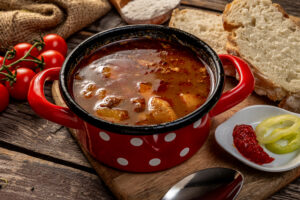
Gulyás, usually known abroad as goulash, deserves attention, though it is often misunderstood. In Hungary it is generally a soup rather than the dense stew some travellers expect: beef, potatoes, root vegetables, paprika and caraway cooked into a deeply savoury broth. It is warming without being excessively heavy, especially on a cold or rainy Budapest day.
Pörkölt is the more concentrated stew, commonly made with beef, pork or chicken and served with nokedli, small irregular dumplings similar to spaetzle. Paprikás, particularly chicken paprikash, takes a gentler route, balancing paprika with a creamy sauce. These are dishes worth ordering in a traditional restaurant, ideally with pickles on the side to cut through their richness.
Other staples reveal the breadth of Hungarian comfort food. Főzelék is a thick vegetable dish, often made with lentils, peas, spinach or squash, and can be served with a fried egg or meat patty. Töltött káposzta, cabbage leaves filled with seasoned meat and rice, is particularly associated with colder months and festive tables. For a broader overview before ordering, browse this guide to traditional Hungarian dishes.
Lángos remains Budapest’s essential street-food stop
Among the city’s most recognisable snacks, lángos is the one visitors should eat freshly fried. The base is a soft yeast dough fried until crisp at the edges and tender inside. The classic topping is garlic, sour cream and grated cheese, a satisfying combination that works best when eaten immediately, ideally standing outside with napkins close at hand.
Modern Budapest has expanded the possibilities with toppings that range from sausage and vegetables to sweeter versions. That variety does not make the dish less traditional; street food evolves with the city. What matters is the quality of the dough, the freshness of the frying, and a topping that does not overwhelm its texture.
For a central introduction, Retro Lángos Budapest serves traditional and gluten-free lángos, alongside vegan and plant-based options, at Bajcsy-Zsilinszky út 25. and Vécsey utca 3. Both are convenient for a break near St. Stephen’s Basilica or the Hungarian Parliament. Visitors looking specifically for a reliable street-food stop can find more practical detail in this guide on where to eat lángos in Budapest.

Markets offer a useful snapshot of everyday ingredients
Budapest’s markets are good places to understand the pantry behind Hungarian food: strings of paprika, jars of preserves, cured meats, cheeses, seasonal produce and bakery counters with early-morning queues. The Great Market Hall is the best-known stop and can be busy, but its scale makes it useful for first-time visitors. Go early if possible, when shopping still takes priority over sightseeing.
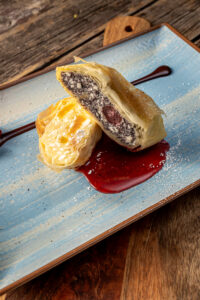
Look for pogácsa, a small savoury biscuit often enriched with cheese, crackling or potato; kifli, a crescent-shaped bread roll; and rétes, the Hungarian relative of strudel, filled with apple, sour cherry, poppy seed or sweet cottage cheese. Market food is not automatically more authentic than a restaurant meal, but it offers an unfiltered view of what people buy for home cooking.
A focused guide to what to eat at Budapest’s Great Market Hall can help distinguish genuine Hungarian products from souvenir-oriented displays. Buy modestly, especially with perishable items, and save room for a proper meal later.
Follow the lunch rhythm for a more local meal
For authentic local food in Budapest, lunchtime is often more revealing than dinner. Hungarian restaurants frequently offer a daily menu, or napi menü, built around a soup and main course. The dishes vary, but the format reflects a practical weekday habit: straightforward, cooked food served at a reasonable pace.
A typical menu might include bean soup, vegetable soup or a clear broth followed by chicken paprikash, a breaded cutlet, pasta with poppy seed, or a seasonal vegetable dish. Choices can be limited, which is usually a good sign. A short menu suggests a kitchen cooking a manageable number of things well rather than trying to satisfy every possible tourist expectation.
Neighbourhood eateries in districts away from the busiest central lanes are useful for this kind of meal. Read the menu carefully, ask staff for help if needed, and do not expect elaborate presentation. The reward is often a direct taste of the dishes Budapest residents actually eat during the working week.
Sweet dishes have their own place at the table
Hungarian desserts lean confidently into fruit, nuts, poppy seeds, cottage cheese and layers of pastry. Dobos torte, with its buttercream layers and crisp caramel top, is the grand café classic. Somlói galuska is softer and more playful: sponge cake, chocolate sauce, walnuts, cream and rum-inflected flavours assembled into a generous bowl.
For something simpler, try túrós palacsinta, thin pancakes filled with sweet cottage cheese, or a slice of rétes. In winter, chimney cake is common around central streets and seasonal markets, although it is better thought of as a festive snack than an everyday Budapest breakfast. A bakery counter with local regulars buying bread and pastries is usually a better indication of daily food culture.
How to eat well with dietary requirements
Budapest is increasingly workable for travellers with dietary needs, though traditional Hungarian food naturally relies on flour, dairy and meat in many familiar dishes. It helps to state requirements clearly and confirm ingredients rather than assuming that a vegetable dish is vegetarian or gluten-free. Soups and sauces may be thickened with flour, while pastries and dumplings are rarely suitable for gluten-free diets.
Vegan food Budapest options have grown beyond international café fare. Plant-based takes on Hungarian dishes, vegetable soups, salads and meat-free street food can all be found, especially in central districts. For coeliac visitors, dedicated gluten-free venues and clearly labelled menus are the safest route. The city’s gluten-free Budapest guide is a useful starting point for planning meals around sightseeing.
A few habits that make the food feel more local
Order with the season in mind. Hearty soups, cabbage dishes and stews make particular sense in autumn and winter, while summer brings stone fruit, cold fruit soups, lighter vegetable plates and outdoor eating. Drink tap water if offered, but do not overlook Hungarian wines, particularly dry whites, or a small glass of fröccs, wine mixed with soda water.
Most importantly, avoid trying to fit every famous Hungarian dish into one day. Budapest food is best experienced in intervals: coffee and pastry in the morning, a market snack, a proper lunch, perhaps lángos on an afternoon walk, then dessert after dinner. That slower approach leaves space for the city itself—and for the unexpected bakery, lunch menu or street-food counter that turns out to be the meal you remember.