Plan Budapest sightseeing by neighbourhood
Budapest sightseeing is easier when you treat the city as a series of walkable districts rather than a long checklist of individual attractions. The Danube divides Buda’s hills from Pest’s broad boulevards, and each side rewards a different pace. Start with the monumental riverfront, then let streets, cafés, markets and side routes fill in the spaces between the headline sights.
For a first visit, allow at least two full days. Pest contains many of Budapest’s major landmarks within a manageable area: St. Stephen’s Basilica, the Parliament, the Jewish Quarter, the Great Market Hall and the elegant avenues around Andrássy út. Buda is slower and steeper, with Castle Hill, the Fisherman’s Bastion and Gellért Hill offering the city’s classic panorama.
Trying to cross the whole city repeatedly wastes time. Group your Budapest attractions geographically, keep a little room in the day for an unplanned stop, and use public transport for the longer stretches. A well-paced route feels less like sightseeing duty and more like discovering how the city works.
Begin along the Danube
The Danube is Budapest’s natural orientation line. Begin in central Pest, where the neo-Gothic Hungarian Parliament dominates the embankment. Even visitors who do not take an interior tour should see it from the riverbank and again from Buda, where its long façade looks especially dramatic in late afternoon.
Walk south beside the river to the Shoes on the Danube Bank memorial, a restrained and moving tribute to victims murdered during the Second World War. Give it the quiet attention it deserves. From there, continue towards the Chain Bridge, whose stone lions and suspension structure have connected Buda and Pest since the nineteenth century.
Crossing the bridge on foot is one of the simplest and most rewarding Budapest sightseeing tips. The view gathers the city into one frame: the Parliament downstream, Castle Hill rising ahead, river cruises moving beneath the bridges, and Pest’s dense roofline behind you. Early morning is calmest; around sunset, expect company but also changing light.
On the Buda side, Clark Ádám Square is the point at which you choose between Castle Hill and the riverside. Take the funicular if it is operating and the queue suits your schedule, but walking uphill is often faster and gives you better glimpses of the city through the trees and old walls.
See Castle Hill beyond the postcard view
Castle Hill holds several of the best things to see in Budapest, but it is worth exploring beyond the busiest terraces. Start near Matthias Church, identifiable by its richly patterned tiled roof. The surrounding Trinity Square can be crowded in the middle of the day, so arrive early if you want photographs without a constant stream of tour groups.
The Fisherman’s Bastion is famous for its white-stone towers and wide view over the Parliament. Its fairytale appearance can distract from the real pleasure of the place: looking across the Danube and tracing the city’s geography. The covered arcades and quieter lanes behind the church offer a welcome break from the main viewing platforms.
Continue towards Buda Castle, now home to cultural institutions including the Hungarian National Gallery and the Budapest History Museum. Even without entering, the courtyards, terraces and gateways justify the walk. Castle Hill’s cobbled streets are uneven, so sturdy shoes are sensible, especially after rain or in winter.
For visitors keen to build a fuller cultural itinerary, this guide to the best Budapest museums helps identify collections that deserve time beyond a quick look at their exteriors. The city’s museums are spread across both sides of the river, making them useful anchors for a wet afternoon.
Give Pest’s grand landmarks a full day
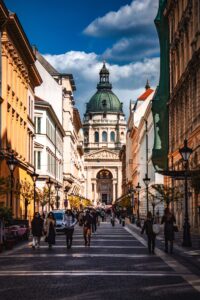
Back in Pest, begin at St. Stephen’s Basilica. Its dome is a defining part of Budapest’s skyline, and the viewing terrace provides a close-up alternative to the hills of Buda. Check current visiting arrangements before arriving, particularly if you want to climb or take the lift to the top.
From the basilica, walk through the centre towards Liberty Square, where monumental architecture sits alongside reminders of Hungary’s complicated twentieth-century history. The Parliament is a short walk away. If an interior tour matters to you, book it ahead rather than assuming tickets will be available on the day.
Later, head east towards Heroes’ Square at the entrance to City Park. The square’s Millennium Monument is imposing, while the park provides a softer counterpoint: paths, trees, the Vajdahunyad Castle complex and, seasonally, outdoor activities around its lake. This route follows Andrássy út, a handsome avenue lined with nineteenth-century buildings and cultural institutions.
Budapest’s yellow Metro line, known as M1, runs below Andrássy út and is an attraction in its own right. Its compact historic stations make the journey feel distinct from a standard underground ride. For practical details on using trams, buses and the metro, consult this clear guide to Budapest public transport tickets and travel tips before setting out.
Use viewpoints at the right time of day
Budapest looks best when seen at different heights. Fisherman’s Bastion is the obvious first viewpoint, but Gellért Hill gives a broader sweep of the bridges and central river corridor. The climb is demanding in warm weather, so take water and avoid treating it as a rushed detour between appointments.
For a more central option, the dome terrace at St. Stephen’s Basilica brings you into the city’s roofscape. The Buda Castle terraces are another easy choice, particularly around dusk when the Parliament lights up across the river. A river cruise can also be worthwhile in the evening, though it is best seen as a complement to walking rather than a substitute for it.
Photographers should resist scheduling every viewpoint at midday. Low morning light favours the east-facing Buda panorama, while late afternoon and blue hour bring more texture to Pest’s façades. For a broader selection of terraces, hills and lesser-known lookouts, explore these Budapest viewpoints with panoramic city views.
Make room for markets, street food and ordinary city life
Some of the most useful Budapest sightseeing tips concern pauses rather than monuments. The Great Market Hall near Liberty Bridge is a lively place to see Hungarian produce, paprika displays, cured meats, cheeses and food stalls. It can be busy, especially later in the morning, but it remains a practical stop if you are exploring the southern end of central Pest.
Lángos, the fried Hungarian flatbread, makes more sense as a substantial snack or informal lunch than as a token bite squeezed in after dinner. The traditional version is often topped with sour cream and cheese, though toppings vary widely. It is best eaten freshly made, while the exterior is crisp and the centre still soft.

Near St. Stephen’s Basilica and the Parliament, Retro Lángos Budapest has locations at Bajcsy-Zsilinszky út 25. and Vécsey utca 3., making it an easy food stop between central sights. Alongside traditional options, it offers gluten-free lángos and vegan, plant-based choices, useful for mixed groups with different dietary needs. A wider Budapest food tour guide can help you plan further Hungarian dishes, markets and local meals around your sightseeing route.
The Jewish Quarter is another good area for stepping away from formal attractions. Its courtyards, independent shops, cafés and bars change character throughout the day. Visit the Dohány Street Synagogue with appropriate time and respect, then wander without trying to turn every block into an item on an itinerary.
Practical habits that improve a Budapest visit
Buy transport tickets before boarding where required and validate paper tickets correctly. Budapest has frequent ticket inspections, and a misunderstanding is still treated as a problem. Use the city’s trams whenever possible: lines along the Danube are particularly useful for connecting sights while letting you see more than you would underground.
Wear shoes suitable for cobbles, hills and long pavements. Keep a light layer for riverside evenings, even after a warm day. In summer, plan exposed sights early or late and reserve museums, cafés or thermal baths for the hottest hours. In winter, darkness arrives early, which makes illuminated river views easy to fit into an afternoon route.
Finally, do not attempt every landmark. Choose one river walk, one major cultural sight, one elevated viewpoint and one proper Hungarian meal each day. Budapest rewards that measured rhythm: a tram rattling beside the Danube, a sudden view between Buda’s old houses, and a warm lángos break can stay with you as clearly as the grandest façade.